U.S. Rate Cuts: Continued Macroeconomic Support, While Bitcoin Remains on the Sidelines
Analysis by Jean Guillou, Chief Investment Officer I Vancelian
The recent decision by the U.S. Federal Reserve to lower its key interest rates by 25 basis points, bringing the main policy rate to 3.75%, continues the easing cycle initiated in recent months. This now-confirmed monetary policy shift aims to support economic growth while maintaining financial stability.
While this decision has produced visible effects on several asset classes—equity markets, rates, and currencies—it does not yet constitute a sufficient catalyst to trigger a significant recovery movement in the cryptocurrency market, which remains on the sidelines compared to other segments.
Bond Market: Measured Relief, Caution Remains
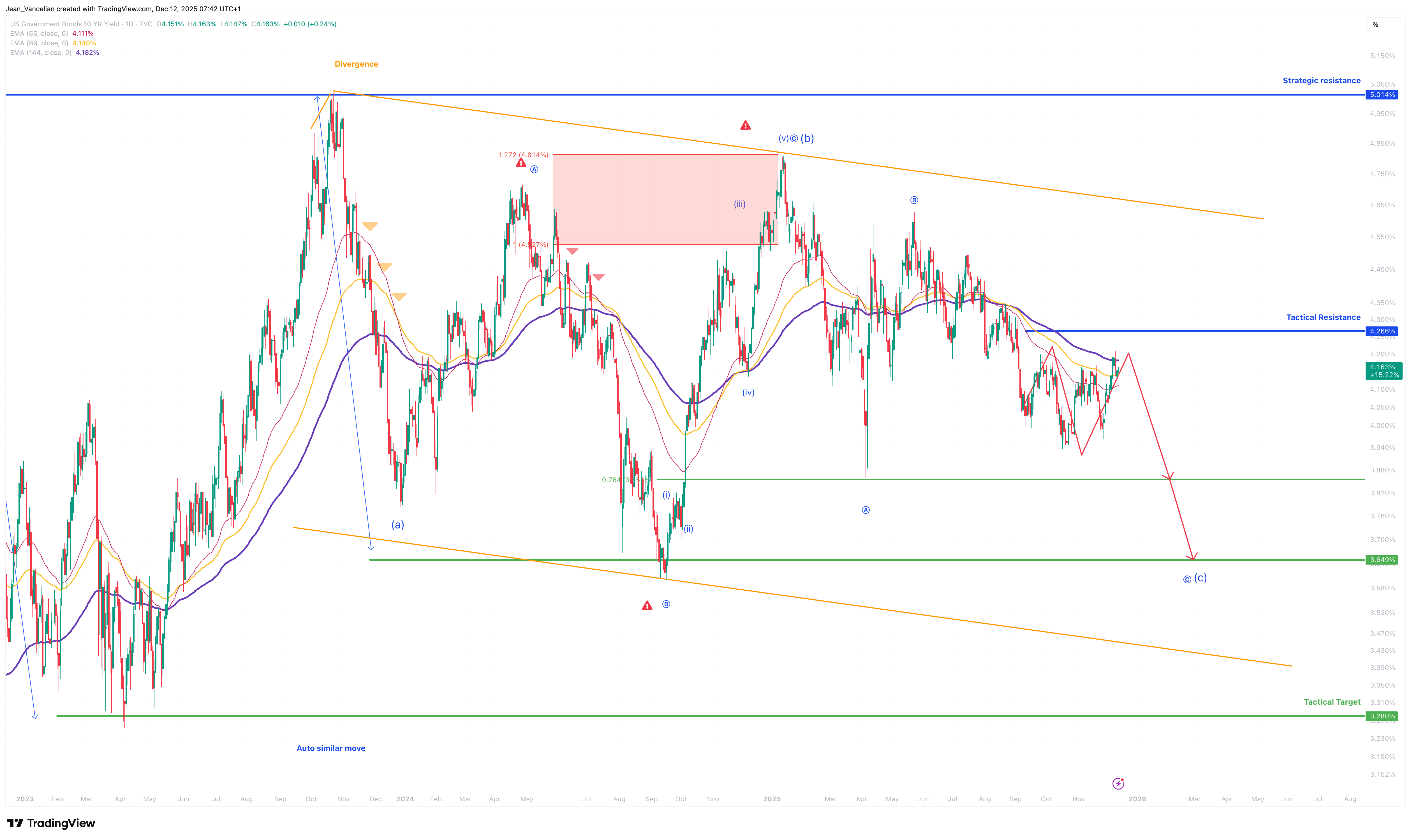
In the U.S. bond market, yields have slightly declined, reflecting the mechanical impact of the rate cut. This relief was reinforced by the announcement of monthly Treasury purchases worth $40 billion, designed to improve liquidity and stabilize the yield curve.
The Fed made its decision amid still-limited visibility on the trajectory of inflation and employment, while medium-term fiscal stimulus prospects could reignite certain inflationary pressures. In this context, the observed decline in yields appears more as a short-term adjustment than as the beginning of a sustained deep bond market easing cycle.
10-Year US rate
Equity Markets: New Records in the U.S., Ongoing Sector Rotation
In equity markets, the rate cut clearly supported the overall momentum. The S&P 500 and Dow Jones reached new all-time highs, confirming the resilience of the U.S. economy and persistent investor confidence.
However, this progress was accompanied by a notable shift among sectors. Allocations have gradually reoriented toward sectors more directly exposed to the real economy—industry, materials, finance—while certain major technology stocks have paused relatively. This movement is partly explained by growing questions about the scale, pace, and cost of investments related to artificial intelligence.
This is not a rejection of the technology sector (bubble), but rather a healthy rebalancing of portfolios after a prolonged period of highly concentrated performance.
It is also important to note that many equity stocks now exhibit volatility levels comparable to those historically observed in certain cryptocurrencies, while resting on much more solid fundamentals and cash flows.
This evolution helps explain the relative underperformance of the crypto market compared to the Nasdaq or S&P 500.
Currency and Precious Metals Markets: Continued Structural Dollar Decline, Gold Surge
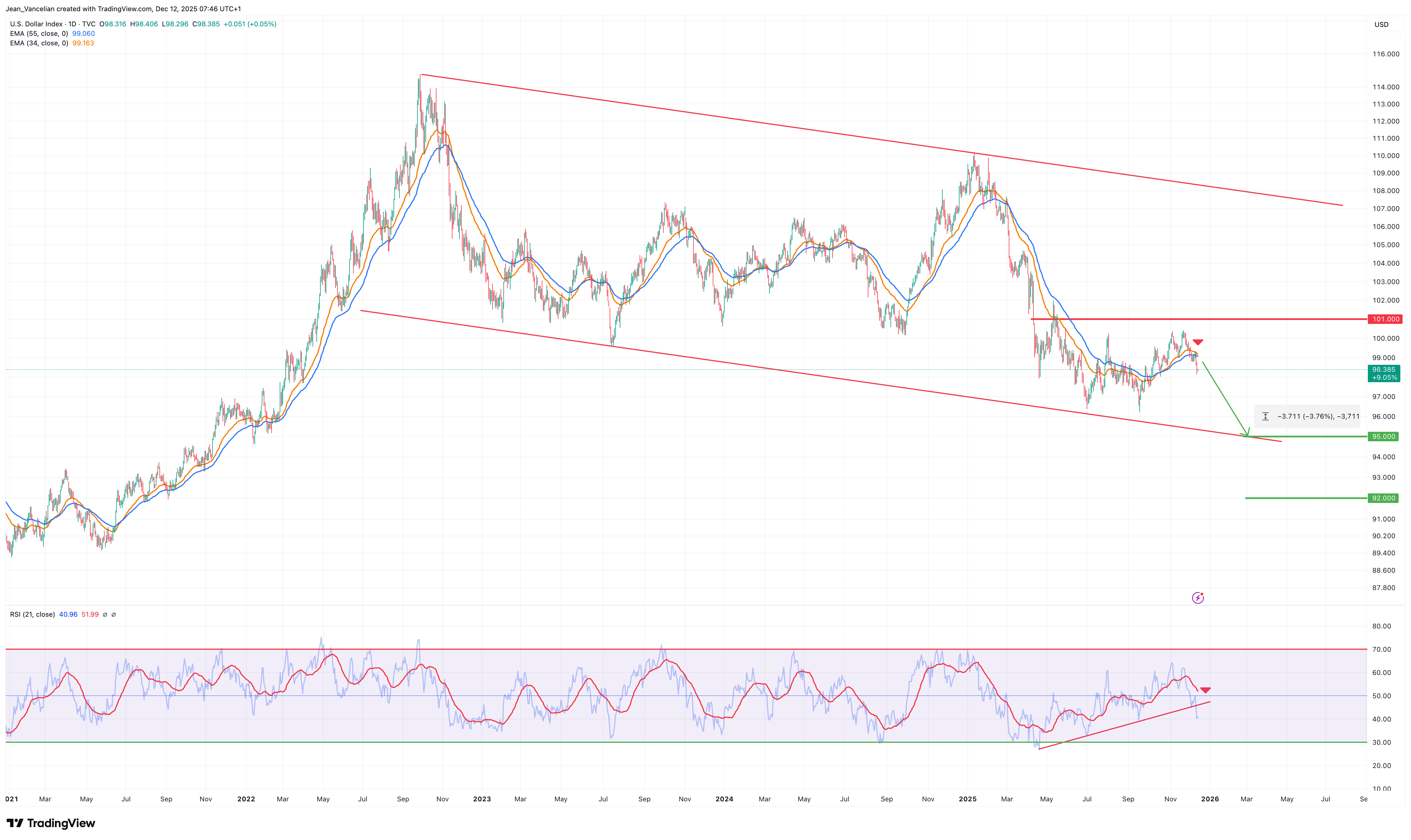
The U.S. rate cut has also led to a narrowing of rate differentials between the Federal Reserve and other major central banks.
This dynamic is reinforced by the announcement of monthly Treasury purchases, which increases liquidity in circulation and weighs on the Dollar.
This evolution must be considered by investors exposed to non-dollar currencies, particularly those using dollar-based yield or preservation tools. In many strategies, the underlying asset remains denominated in USD, leading to a gradual erosion of real performance. Currency risk management thus becomes a central parameter of allocation.
Finally, the combination of declining real rates and dollar weakness mechanically benefits the gold market. As a non-yielding asset, the precious metal sees its attractiveness strengthened while directly benefiting from dollar weakness, explaining the strong increase in its price.
Dollar Index - DXY
Bitcoin and Crypto: Liquidity Flight and Marked Underperformance
In this macroeconomic environment generally favorable to risky assets, Bitcoin did not react immediately to the monetary easing. This lack of short-term correlation is mainly explained by factors internal to the cryptocurrency market.
The massive liquidations observed on October 10 (Crypto Crash) durably weakened positioning and degraded market sentiment. Moreover, the Fed's decision was largely anticipated and already priced in. Historically, the effects of a central bank balance sheet expansion spread gradually: first to money markets, then to risky assets, with a lag that can extend over several months.
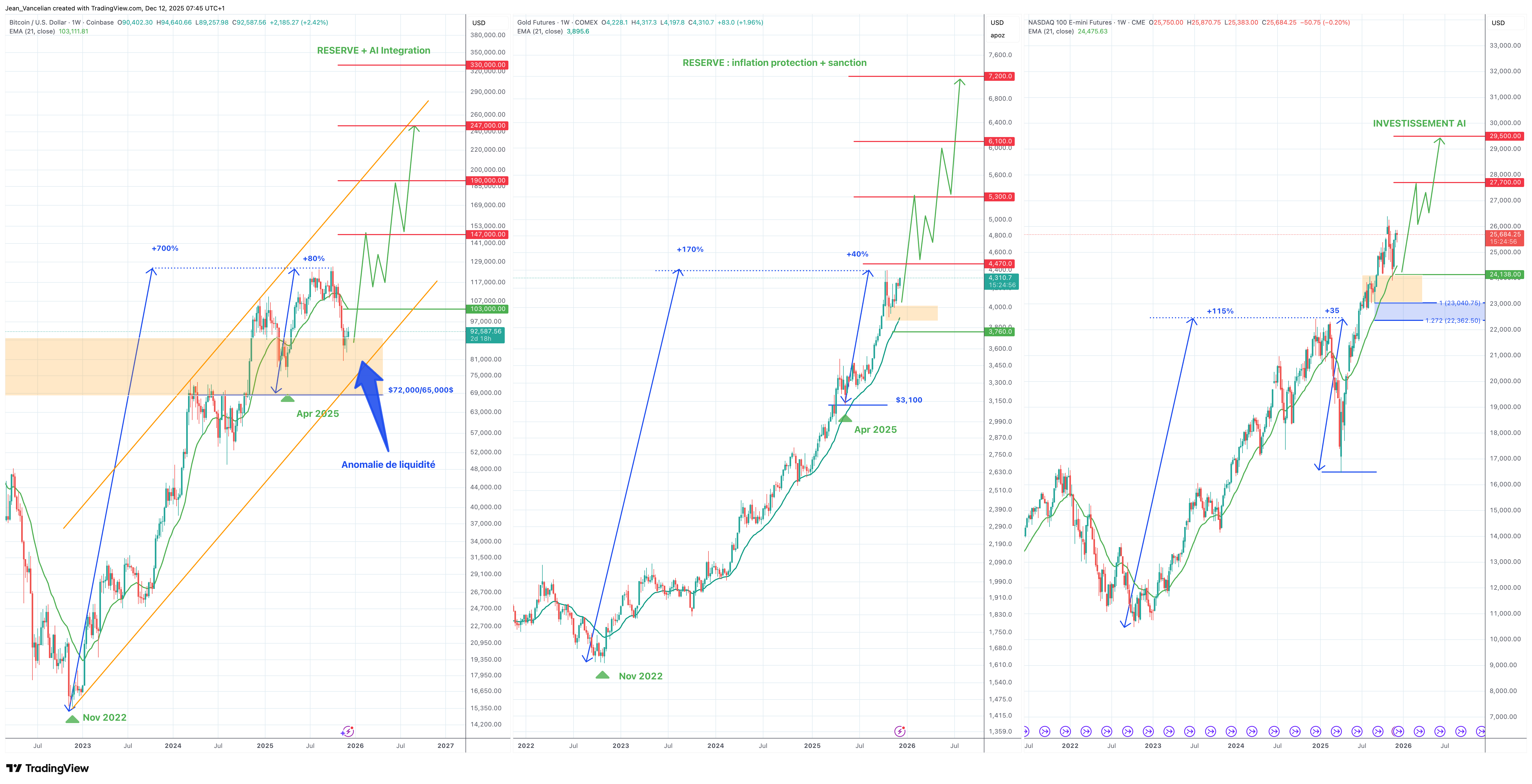
In October and November, Bitcoin decoupled from gold, silver, and the Nasdaq—with which it had previously evolved in relatively synchronized fashion. This decoupling reflects more a temporary liquidity anomaly than a challenge to long-term fundamentals.
Bitcoin vs. Gold vs. Nasdaq
Technical Levels & Scenario for Bitcoin
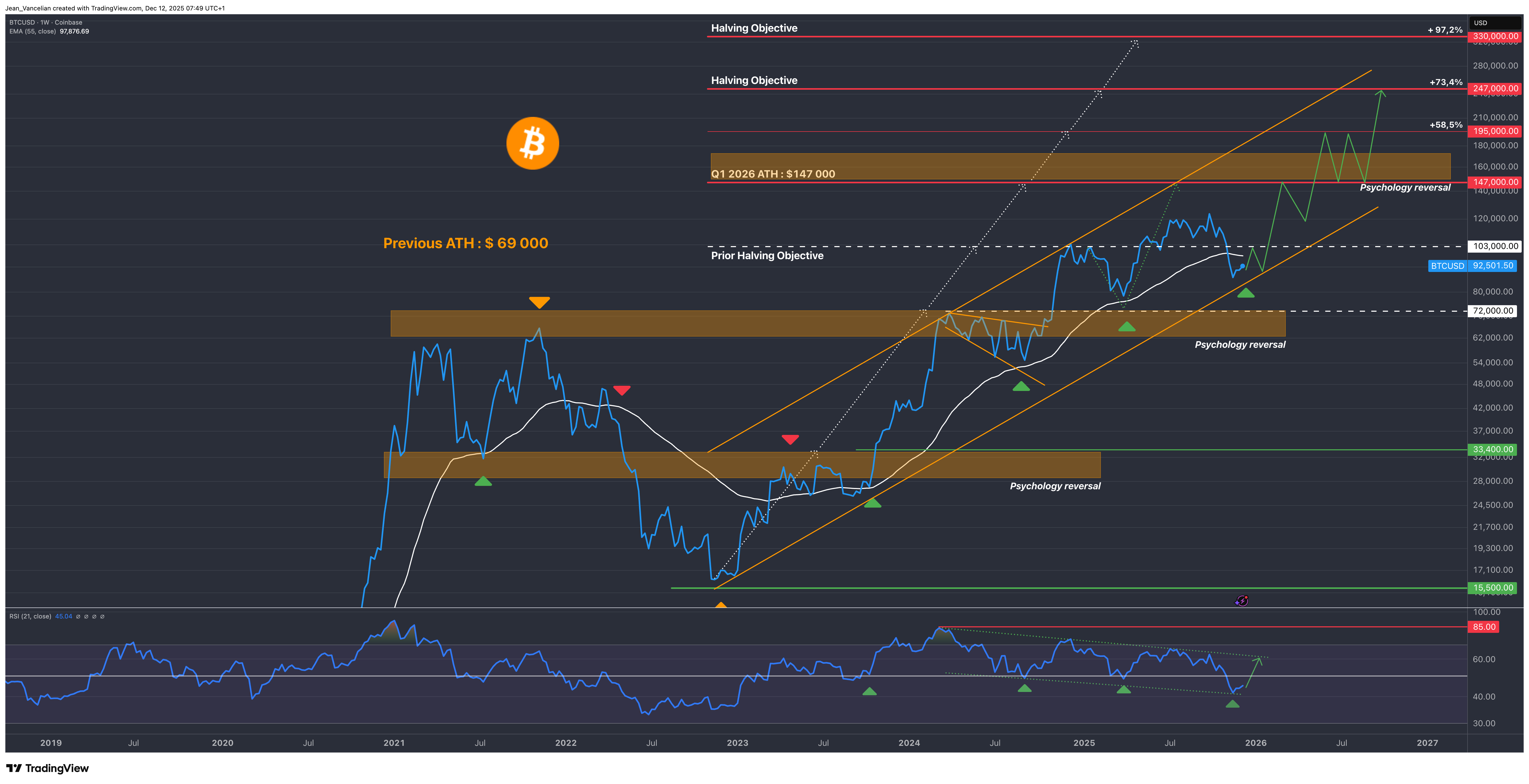
To restore the situation, a sustainable reintegration of the $101,000 – $103,000 zone is necessary. As long as this threshold is not crossed on a weekly close, the recovery will remain gradual, with the market needing to rebuild its liquidity and confidence.
On the downside, the $72,000 – $65,000 zone constitutes the strategic floor for the coming months. It represents a foundational building zone compatible with a scenario of gradual and disciplined recovery.
The central scenario remains unchanged: U.S. monetary easing constitutes structural support for risky assets, but its effect on Bitcoin unfolds over time. This consolidation phase could persist before a more dynamic recovery, with an objective of testing the $147,000 zone in the first half of 2026, subject to a gradual return of global liquidity to Bitcoin.
Bitcoin Weekly chart (Log)